
 PartnersCase studyPressBlogFAQ



Web3 Wallet Scoring: Stop Sybil Attacks & Cut CAC
Acquiring users in Web3 is expensive. That is just reality. But when bots and professional farming operations (sybils) hijack your campaigns, "expensive" quickly turns into "catastrophic."
Let’s be honest: most Web3 projects are simply burning their marketing budgets to subsidize auto-clickers and multi-accounting setups.
Classic doom loop |
|---|
You allocate $100,000 for a campaign, expecting to acquire 50,000 real users at a $2 Customer Acquisition Cost (CAC). On paper, it looks perfect. In reality, 70% of participants are farmers. You spent entire $100K but only acquired 15,000 real people. Your actual CAC just spiked to $6.6. |
Every quarter, marketing teams step on exact same rake:
Launch campaign → Distribute rewards → Farmers flood in.
Realize too late that budget was wasted.
Try to claw back rewards or ban bad actors post-factum (always a failure).
Run exact same playbook next quarter with even worse economics.
Core problem? You are trying to filter out bots after money is already gone.
Solution: Wallet Scoring. It flips entire model upside down: you evaluate quality of audience before spending a single dollar.
Anatomy of budget bleeding: Why legacy Web3 economics are broken
Standard Web3 marketing funnel sounds simple: launch quest → users complete tasks → distribute tokens. In practice, however, this execution is an absolute disaster.
Metric | Expectations | Harsh Reality |
|---|---|---|
Bot/Farmer Share | < 10% | 70% — 90% |
CAC | $1 – $2 | $20 – $30 (per qualified user) |
Reward Destination | Hold & Product Engagement | Instant dump on market |
Campaign ROI | Positive | Destroyed |
Why traditional Sybil protection fails at scale?
Farmers have evolved. They easily bypass basic security: they pass KYC, "warm up" their wallets, simulate realistic activity, and route through unique IPs.
In a desperate bid to protect themselves, projects tighten rules - forcing users to jump through 15 bureaucratic hoops just to claim a $5 reward. Who does this stop? Certainly not professional farmers who have automated this entire flow. Instead, real users get frustrated and leave.
What is wallet scoring and how does it work?
Wallet scoring is an on-chain reputation assessment framework. Instead of relying on easily faked Web2 data (like Twitter or Discord accounts), system analyzes wallet's permanent "digital footprint" on blockchain.
Instead of looking only at wallet age or balance (which are trivial to manipulate), wallet scoring evaluates complex, multi-dimensional behavioral patterns.
5 on-chain signals that cannot be faked:
Transaction diversity: High-quality wallets interact with diverse protocols (DeFi, NFTs, DAOs, social dApps). Farmers usually optimize for a single target action and ignore everything else.
Asset holding duration: Real users hold assets over time. Farmers operate on a "claim and immediately bridge/dump" loop. Average holding time reveals true intent.
Interaction patterns: Human behavior is chaotic. Farmers act like machines: hundreds of wallets executing identical transactions at highly coordinated times.
Network effects: Genuine wallets organically cross paths with other active users. Sybils exist in isolated clusters or connect back to a single "parent" address.
Value creation vs. value extraction: High-quality wallets provide liquidity, participate in governance, and actively engage. Farmers do nothing but extract rewards and vanish.
Ultimate defense: Gaming a sophisticated, multi-dimensional scoring system is economically unviable. cost required to properly "warm up" hundreds of wallets exceeds potential farming payout.
New math of growth: How numbers shift
Implementing wallet scoring completely restructures economics of Web3 marketing:
Assess Quality Upfront -> Exclude Low-Score Wallets -> Direct Budget to Verified Users |
Quick numerical example:
You have a campaign budget of $50,000.
Without Scoring: You distribute rewards evenly across 10,000 participants (where 7,000 are sybils). Your budget is effectively incinerated.
With Scoring: You divide participants into tiers:
High-score wallets (verified users): Receive 100% of reward
Medium-score wallets: Receive a scaled-down reward
Low-score wallets (bots/sybils): Are automatically excluded
Result: Your budget reaches real users with 80-90% efficiency, your actual CAC drops by 40–60%, and your campaign ROI becomes predictable before launch. You don't have to manually fight bots—you simply make farming your project unprofitable for them.
Claimr: Out-of-the-box infrastructure to safeguard your budget
Building on-chain analytics from scratch requires months of development, node maintenance, and writing complex parsing algorithms. Claimr solves this entire infrastructure headache out of box.
Claimr’s wallet scoring engine is natively integrated and supports major ecosystems, including EVM chains, non-EVM networks, and Sui.
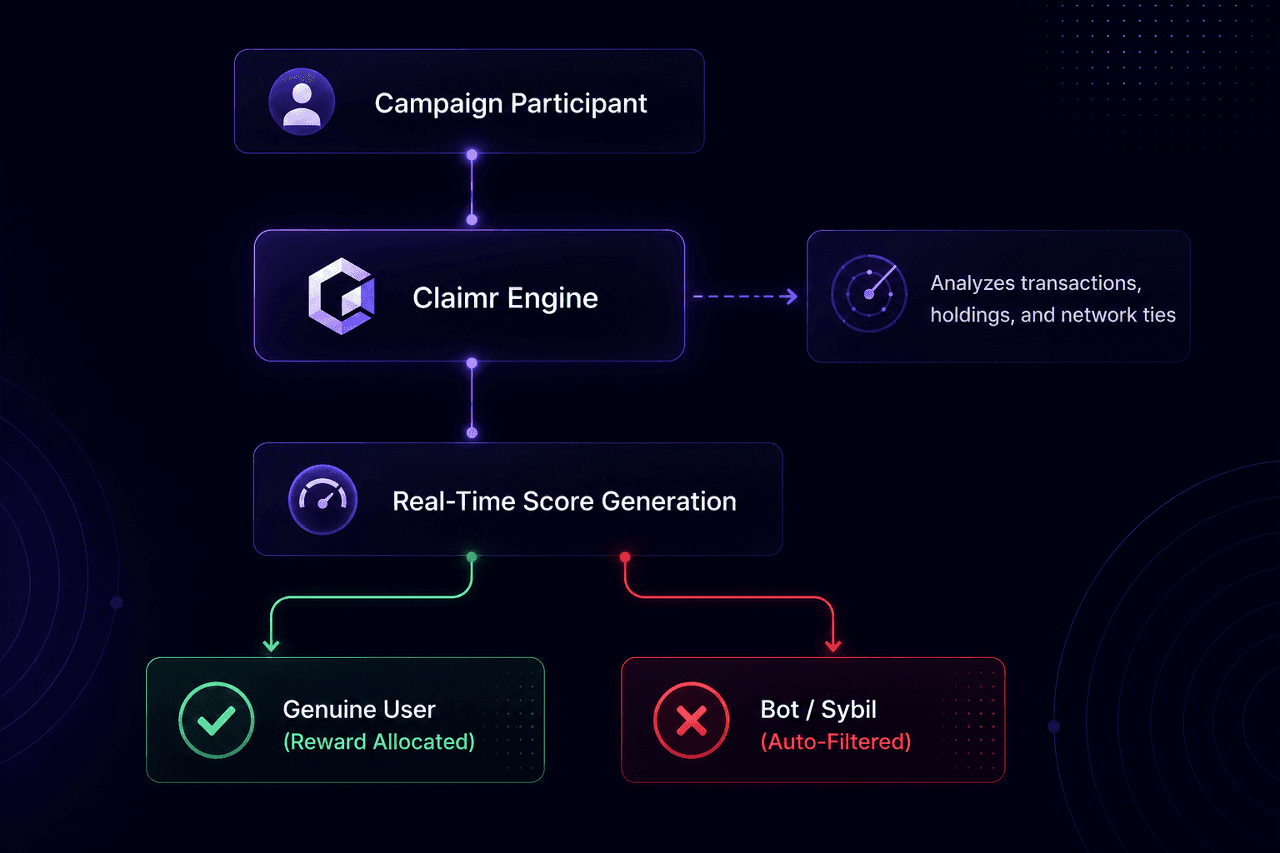
With Claimr, you get:
Smarter TGEs & Token Sales
Give priority allocation to proven long-term holders and active ecosystem contributors, rather than wallets primed to dump immediately post-TGE.
Automated Quests & Airdrops
Forget manual CSV filtering. Automatically scale rewards based on real-time wallet reputation scores.
Deep Retention Analytics
Track how on-chain reputation of acquired users translates to long-term Retention and Customer Lifetime Value (LTV).
⚡️ Scale your growth, not your losses
Continuing to run legacy Web3 marketing playbooks is a fast track to bleeding capital. You can either continue to subsidize bot farms, or you can start managing your growth budget using data.
Wallet scoring is not an incremental feature. It is core survival mechanism for Web3 marketing.
Slash CAC by 40–60%
Double your user retention
Attract community members who actually care about your product
Data is public. Technology is ready. Choice is yours: feed bots or build a thriving community with Claimr⚡️