 PartnersCase studyPressBlogFAQ


Gamified Reward Programs for Crypto Startups: A Practical Guide
Most reward programs don't fail because of the rewards
Launching a reward campaign has never been easier. Real challenge begins after users collect their first reward.
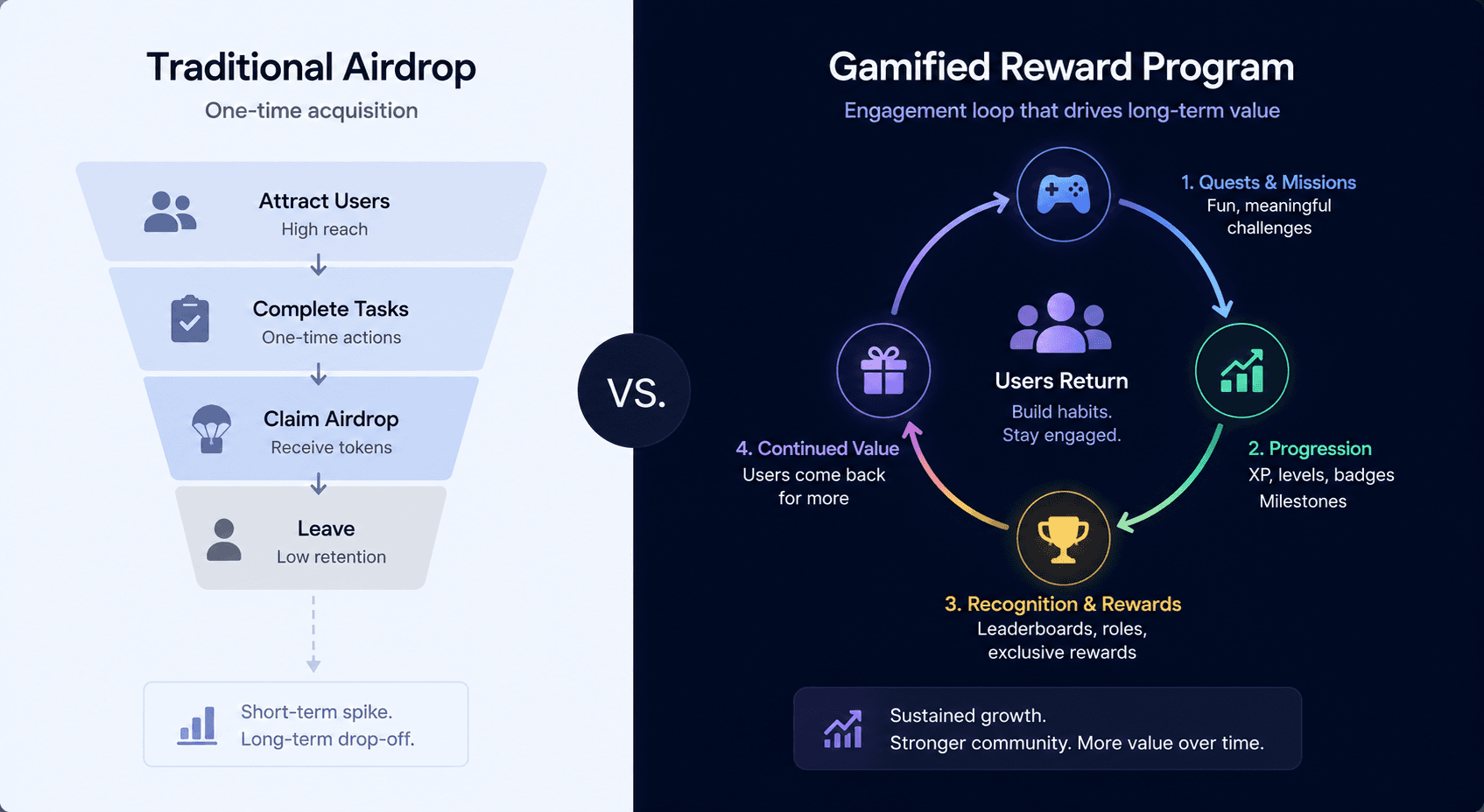
This is where many Web3 projects struggle. A campaign attracts thousands of wallets, social channels fill with new followers, and dashboards show impressive acquisition numbers. Yet a week later, activity drops, users disappear, and the community looks almost identical to how it did before the campaign launched.
Problem usually isn't reward itself - it's behavior being rewarded.
Many teams still optimize for one-time actions such as connecting a wallet, following an X account, or claiming tokens. Those metrics are easy to measure, but they rarely reflect meaningful product adoption. Successful projects think differently. Rather than asking, "How do we get more users?", they ask, "What would make users come back next week?"
That's where gamification stops being a marketing tactic and starts becoming a retention strategy.
Build your reward program around user behavior
One of the most common mistakes is starting with the rewards themselves.
Questions like "How many points should we give?" or "What NFT should users earn?" seem logical, but they're actually the wrong place to begin. First question should always be: "What behavior creates long-term value for our product?"
Every product has its own engagement loop. For a DeFi protocol, it might be staking, voting, and returning regularly to manage positions. For a GameFi project, it could involve completing quests, unlocking achievements, and inviting friends. Whatever that journey looks like, your rewards should reinforce it - not distract users with activities that look good in a report but add little value to the ecosystem.
Once journey is defined, rewards become much easier to design. Low-effort actions help users get started, while more meaningful behaviors deserve greater recognition. A governance vote, for example, contributes far more to your ecosystem than following a social media account, so it shouldn't be rewarded the same way.
Low-value actions | High-value actions |
Follow on X | Complete an on-chain transaction |
Join Discord | Stake assets |
Connect a wallet | Vote in governance |
Visit a landing page | Invite an active referral |
The goal isn't simply to distribute points - it's to guide users toward the behaviors that make your product stronger.
Progress matters more than bigger rewards
One assumption appears in almost every unsuccessful reward program: if users receive bigger rewards, they'll become more engaged.
In reality, the opposite is often true.
What keeps people involved isn't another 20 XP or a slightly larger token payout. It's the feeling that they're making progress. Progress bars, levels, achievement badges, seasonal leaderboards, and evolving NFT rewards all reinforce the same psychological trigger: I'm getting closer to the next milestone.
Imagine a new user joining your platform. They connect their wallet and earn their first XP. A few quests later, they unlock a Silver badge. The following week they're one challenge away from reaching Gold status and entering the top 100 on the leaderboard. None of those milestones are particularly expensive to create, yet together they provide a clear reason to return.
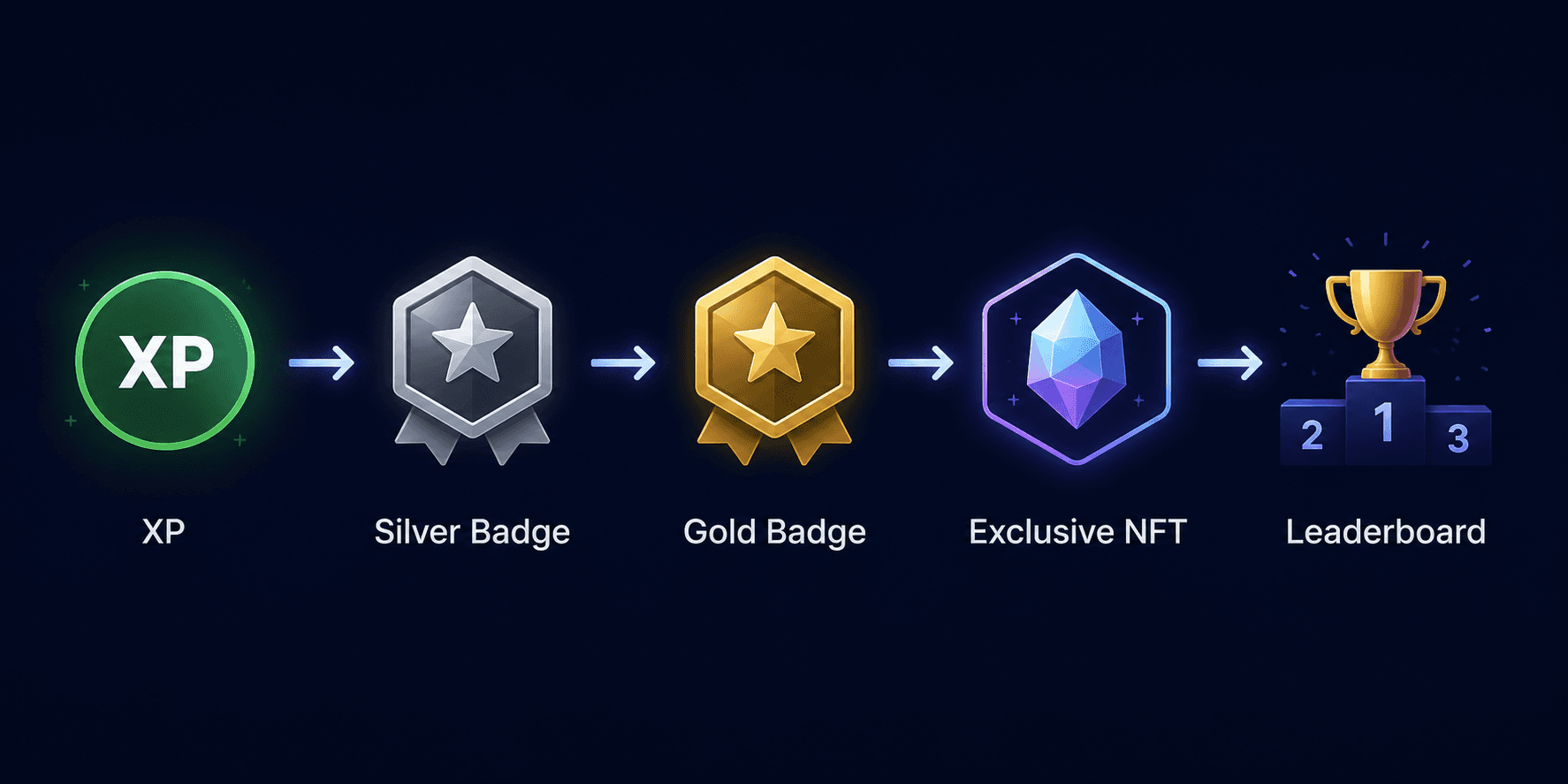
This is why the best reward programs feel like journeys rather than promotions. Users aren't chasing rewards - they're building momentum.
Mistakes that quietly kill engagement
After enough campaigns, same patterns begin to appear.
First is reward inflation. When users earn thousands of points for almost every action, those points quickly lose their meaning. Smaller, carefully balanced rewards create a much stronger sense of achievement over time.
Second is focusing on vanity metrics. Wallet connections, impressions, and social follows may look impressive in reports, but they don't tell you whether people actually adopted your product. Metrics such as quest completion rate, returning users, holder retention, and cost per completed quest provide a much clearer picture of campaign performance.
Finally, many projects treat reward campaigns as one-time events. Users complete a few tasks, claim their rewards, and have no reason to come back. Strongest programs avoid this by ensuring that every completed quest naturally leads to another milestone, another season, or another opportunity to participate.
A successful reward program doesn't end when users claim their rewards. That's when the next engagement loop should begin.
Focus on the experience - not the infrastructure
Designing a good reward program requires constant iteration. Building the underlying infrastructure shouldn't.
Many teams spend weeks developing progression systems, point logic, analytics, smart contract integrations, and notification flows before they can even launch their first campaign. Those are necessary components, but they aren't what makes a reward program successful.
Platforms like Claimr remove that engineering overhead with reusable quest templates, built-in progression systems, dynamic NFT rewards, analytics, and integrations with tools like Discord and Telegram. Instead of rebuilding the same mechanics every time, product teams can focus on improving the experience users actually interact with.
Success in Web3 doesn't go to the projects giving away the biggest rewards. It goes to those that create experiences users genuinely want to return to.
Ready to build your own gamified reward program? Book a demo and turn engagement ideas into live campaigns in minutes.